

Why planning maturity is a profit lever
Growing revenue and holding margin is hard in a market of complex projects, tight regulation and competitive tendering. Add the usual uncertainty around scope, interfaces, supply chains and approvals, and the margin exposed to time overruns gets large fast.
In that environment the maturity of your planning process becomes a commercial advantage in its own right. Planning maturity is the mix of process, skills, tools and culture, and it feeds straight into forecast reliability, recovery of time related costs, and how confidently your leaders can make calls on risk, bids and growth.
When maturity is low, the symptoms are familiar. Planning gets treated as passive scheduling. Every project runs its own approach. Data sits in fragments. Reporting tracks past progress and rarely models forward scenarios. The result is more unplanned compression, more spend on avoidable time risk, and a weaker hand when a change event lands on your desk.
AI won’t fix a broken process. It will scale it.
AI is in every second headline, and plenty of contractors are running pilots that promise predictive insight or automated reporting. Most enterprise AI projects fail for one reason: they get run as data or technology projects, when the real change needed is to how the business plans and controls its work.
AI return behaves like multiplication, not addition. Strong data multiplied by weak process maturity still lands you near zero. Feed more data into a model built on fragmented planning and all you do is hardcode today’s weaknesses into next year. Context matters as much as the raw data here. The basis of programme, the change history, the delivery strategy behind a schedule: those are what decide whether a plan is reliable enough to make a decision on.
So lifting planning maturity is one of the most practical things you can do to get AI ready. Structured, contextual planning data tied to repeatable workflows gives a model something worth learning from. Outcome-only schedule data, with no record of why a plan looked the way it did, gives it almost nothing.
From scattered schedules to structured planning intelligence
A lot of contractors still run programmes out of folders, emails and spreadsheets. Plans live as standalone files, revision history is patchy, and the reason a schedule was built a particular way is almost never written down. Six months on, those files are close to useless for learning or for training anything, and “performance insight” is really just anecdote.
Move to structured planning intelligence and the maths changes. Schedules, baselines, revisions and context all sit in a governed environment, so teams can see what matters and act on it. Plans stop being one-offs and become reusable knowledge: capture what worked on one job, reuse it on the next, cut the rework.
At portfolio level this becomes a connected planning ecosystem. Planning data no longer hides in isolated files or on one planner’s laptop. Teams, schedules and systems link up, everyone works from one plan, and a question like “which contracts consistently finish on time, and why?” gets a genuine, evidence-based answer.
How Asta Powerproject and Asta Vision lift planning maturity
For most contractors the journey starts with the right planning tool. Asta Powerproject is built specifically for construction and infrastructure. It models complex real-world sequences accurately while staying usable for planners and delivery teams, with sector templates, fast bar chart manipulation and 4D capability that let you represent a delivery strategy properly and get the team behind it.
Even the best schedule loses its value the moment it’s managed as a standalone file. That’s the problem Asta Vision solves. Vision adds a web-based layer that turns individual Powerproject schedules into a governed, connected planning ecosystem: one secure environment for every programme, revision and supporting record, with company and contract specific workflows that standardise how planning, change and approvals are handled across projects.
Vision manages baselines automatically as workflow steps are taken, and classifies revisions (a progress update, a client change, a scenario plan) so the context stays attached to the schedule instead of vanishing into an inbox. What you get is a living basis of programme you can interrogate later: how the delivery strategy actually evolved, and which decisions moved time and cost the most.
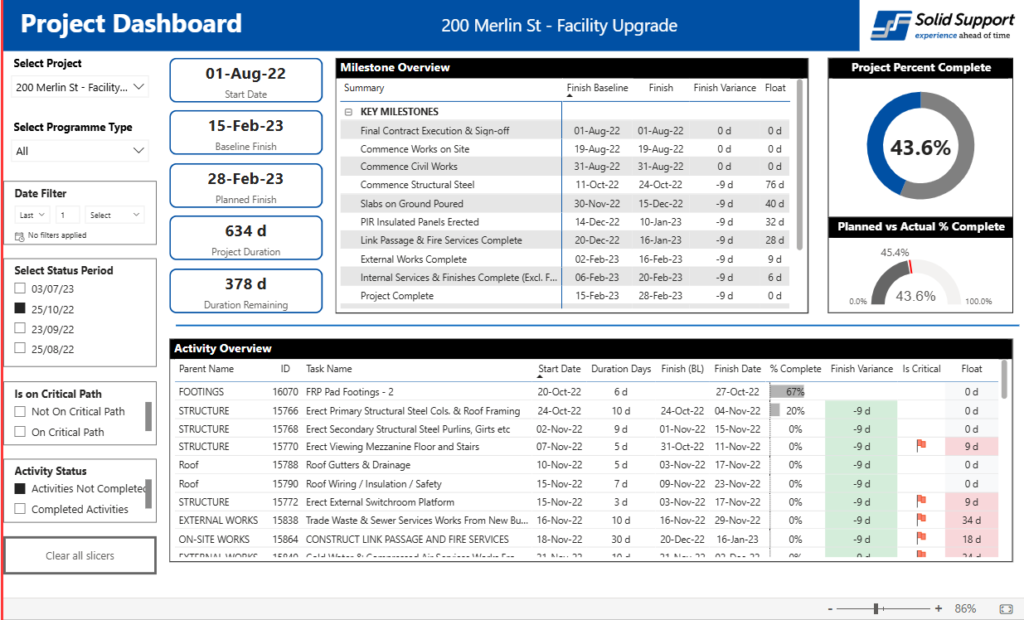
Asta Vision Plus takes it one step on. It exposes that structured schedule data securely through APIs, into dashboards, data platforms and, increasingly, AI-driven tools. Treat Vision as your governed system of record for plan data and the manual exports disappear, while any predictive model or copilot gets a trusted backbone to forecast schedule health, contingency burn and delivery reliability ahead of time.
This is where Solid Support fits. We’re the authorised Australian partner for Asta, and we do more than licence the software. We help contractors across Australia and New Zealand stand up Vision and Vision Plus properly: the workflows, the baseline governance, and the Power BI dashboard layer on top, so the ecosystem maps to how your business actually delivers.
Where the margin actually comes back
Once you run planning as a core business process, the commercial upside gets concrete. Higher planning maturity, built on Asta Powerproject and Asta Vision, lifts profitability in a few specific ways:
- Better recovery of time related costs on client owned change events, backed by transparent baselines, revision histories and hard evidence. This is the core of forensic planning, and it’s where a defensible programme record turns a contested claim into a paid one.
- Less spend on avoidable time risk where the delay is yours, because problems surface earlier and you still have cheap options to deal with them.
- More accurate modelling of complex project and stakeholder requirements, which sharpens your read on time related cost risk and opportunity.
- More competitive pricing with genuine confidence in your forecasts, so you can hold a stronger tender position without quietly carrying more risk.
- Planning data that keeps its value: reusable on future jobs, and ready to work as an asset as AI matures.
The single biggest leak is unmeasured schedule compression. When a job slips, or a scheduling error surfaces late, teams compress the programme to protect key dates. Without consistent baselines, a structured revision history and portfolio-level visibility, that compression happens out of sight. Cost and risk climb, and you get no insight out of any of it.
Govern it with Powerproject for scenario modelling and Vision for baselines and revisions, and the cost of time risk becomes visible. Leaders can start asking sharper questions. What does this change do to our time related costs? How often are we compressing? Which projects hold their dates, and why? Those answers are the business case for investing in planning, and increasingly for AI that reflects how your projects really run.
Where to start
Treating planning as a team sport, where commercial, planning and site delivery all have a stake, is usually the first move towards both stronger margin and AI readiness. The tools and methods you choose touch almost every function, so leaving them to each project locks in low maturity and waters down the value of your own data.
A few practical early actions. Put real delivery experience into your planning roles, so planners shape the strategy rather than just document it. Choose tools that support collaboration, like Powerproject’s visual formats alongside a web environment like Vision, so the team buys in and the plan stays honest to what’s happening on site. And look hard at scheduling systems that build in consistency by design: governed templates, controlled revisions, captured context. That’s the foundation for repeatable workflows and for learning across the business.
The contractors who invest in structured, contextual planning data now will be the ones who can build reliable AI models, stand up to client scrutiny on time performance, and show real innovation at tender stage. The ones still treating planning as a file-based afterthought will struggle to get there, whatever AI tools they buy.
That’s what experience ahead of time really means: seeing where a programme is heading before it gets there, with the evidence to back the call.
Want to see what higher planning maturity looks like on your projects? Talk to the Solid Support team about Asta Powerproject, Asta Vision and Asta Vision Plus, and how to turn your planning data into protected margin, stronger commercial positions and an AI ready backbone for the business.